





Why go solar

The case for commercial solar.

If your premises use power through the working day, your roof could help supply it. Here is the case for commercial solar, built on the figures rather than the sales pitch.

Our installer, Solar4Business, is rated 4.6 out of 5 on Trustpilot.
Installation partnerSolar4Business
Funding partnerINICIO Funding Solutions
Projects delivered for
  • Kingspan
  • Hepworth Clay
  • Swanlea School

The daytime demand advantage

Commercial solar at a glance

15%

Typical rate of return

6-7 yrs

Typical payback

25 yrs

Usual panel warranty

25%

Corporation tax main rate

Commercial buildings are usually the best fit for solar for one reason: they use most of their electricity during the day, exactly when panels are producing it. A warehouse, factory or office with high daytime demand turns most of what it generates straight into savings, rather than exporting it back to the grid at a lower rate.

That is why typical rates of return on commercial solar sit around 15%, with payback in 6 to 7 years against a 25-year panel warranty, leaving well over a decade of largely free generation once the system has paid for itself.

The savings and the tax relief

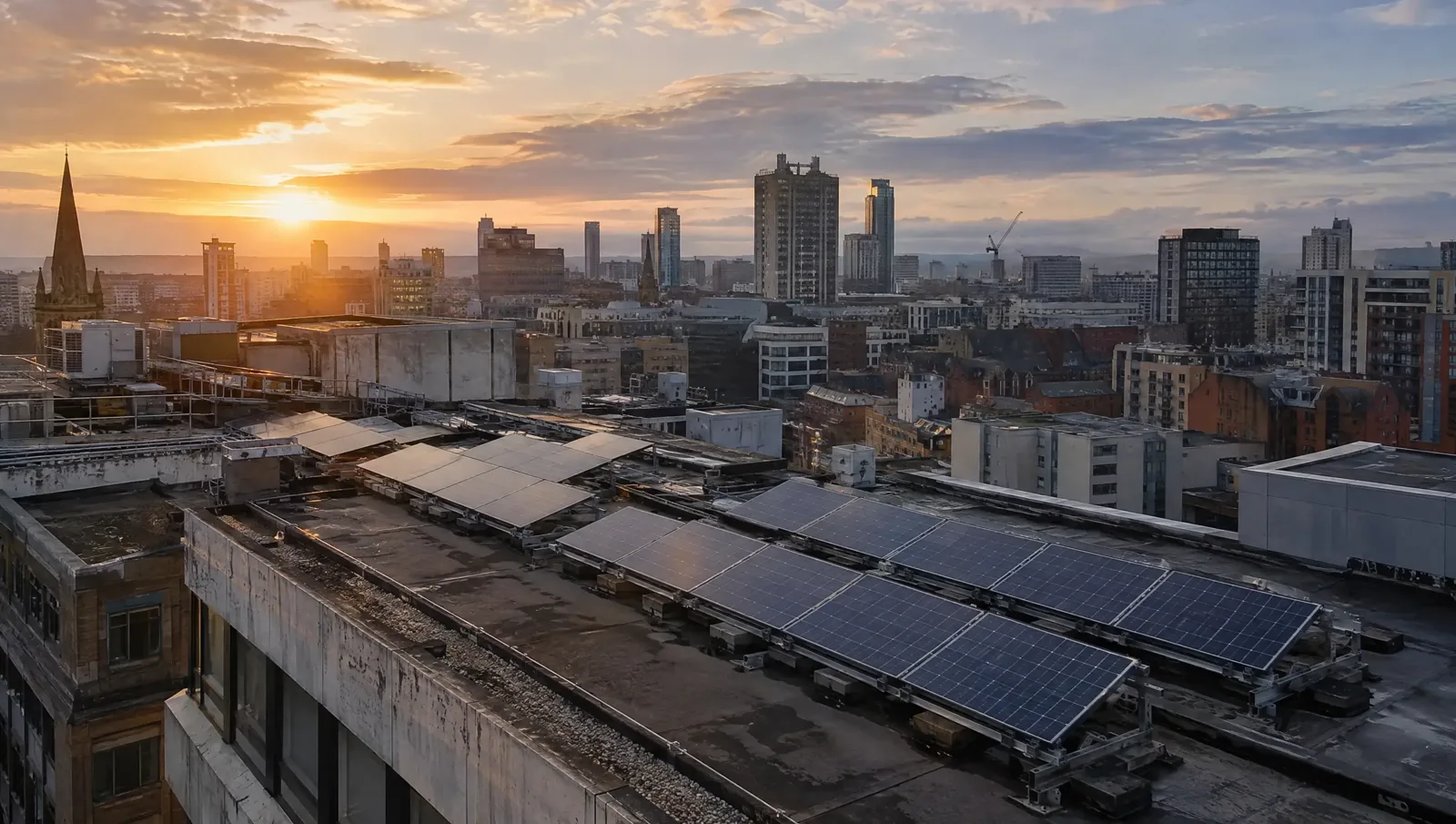
Commercial office building with solar panels on the roof
Every roof is modelled against its own tariff

The average UK non-domestic electricity price was 24.14p/kWh in Q1 2026 (DESNZ). Every kWh your system generates and you use on site is one you don't buy at that rate, and the saving compounds over the life of the system.

Solar PV also qualifies for tax relief. The Annual Investment Allowance lets you deduct up to £1m of qualifying spend against your taxable profits, cutting your effective cost by up to a quarter at the 25% main rate of corporation tax. See our full finance options breakdown for how this works route by route.

The environmental case

Generating your own electricity from daylight cuts your reliance on the grid and on fossil fuels. At the UK's 2026 grid carbon factor of 0.131 kgCO2e per kWh, 10,000kWh of solar used on site avoids around 1.3 tonnes of CO2e a year, alongside the cost saving.

The maintenance case

Solar is low maintenance once installed. Panels need only occasional cleaning and checks, and inverters typically last 10 to 15 years before replacement. It is one of the more predictable investments a business can make.

Weighing it up

The honest case for and against, before you commit to an assessment.

The case for solar

Points to weigh up

Savings that compound

Every unit generated and used is one you don't buy from your supplier, for 25 years or more.

Protection from price volatility

A material share of your electricity comes from your own roof, insulating you from future tariff rises.

Upfront cost, if you buy

Buying outright or on hire purchase means a real cash commitment, though a PPA removes this entirely.

Tax relief available

The Annual Investment Allowance and, above it, the 50% first-year allowance both reduce the net cost.

Low ongoing maintenance

A straightforward asset once installed, with predictable running costs.

Needs the right roof and lease

Shading, roof condition and lease length all affect suitability, which is exactly what your assessment checks.

FAQs

Why commercial solar FAQs

Is solar worth it for a commercial building?

For a business that uses electricity through the working day, usually yes. The typical warehouse solar investment returns around 15%, paying back in 6 to 7 years against a 25-year panel warranty, though every building is different and your own assessment gives you the real numbers.

Does my roof need to be south-facing?

No. Solar generates on east, west and even north-facing roofs, and still produces electricity on cloudy days as panels need light rather than direct sunlight. South-facing roofs at a good pitch simply generate the most.

How much does solar cut my carbon footprint?

The UK grid carbon factor is around 0.131 kgCO2e per kWh (DESNZ, 2026). 10,000kWh of solar used on site avoids roughly 1.3 tonnes of CO2e a year, on top of the electricity cost saving.

What is the biggest drawback of commercial solar?

The upfront cost, if you buy outright or use hire purchase. A larger system can mean a six-figure investment, though a power purchase agreement removes that entirely, with £0 upfront and no capital outlay.

Do I need to own the building?

No, but you will need your landlord's consent if you lease, and your lease needs to run long enough to see the return, or to suit the term of a power purchase agreement.

How long do commercial solar panels last?

Panels typically carry a 25-year performance warranty, and can generate for 30 to 40 years in the right conditions. Inverters usually need replacing every 10 to 15 years.

See the case for your own roof

A free assessment of your bills and roof, with every way to pay modelled side by side.

Get your free solar assessment